
目次 / Contents
1) 曼珠沙華 / Amaryllidaceae
A. 今日 / Today
B. たくさんの名前 / Many Names
2) お面 / Masks
A. 天狗じゃない / Not A Tengu
B. 猿田彦 / Sarutahiko
1) 曼珠沙華 / Amaryllidaceae
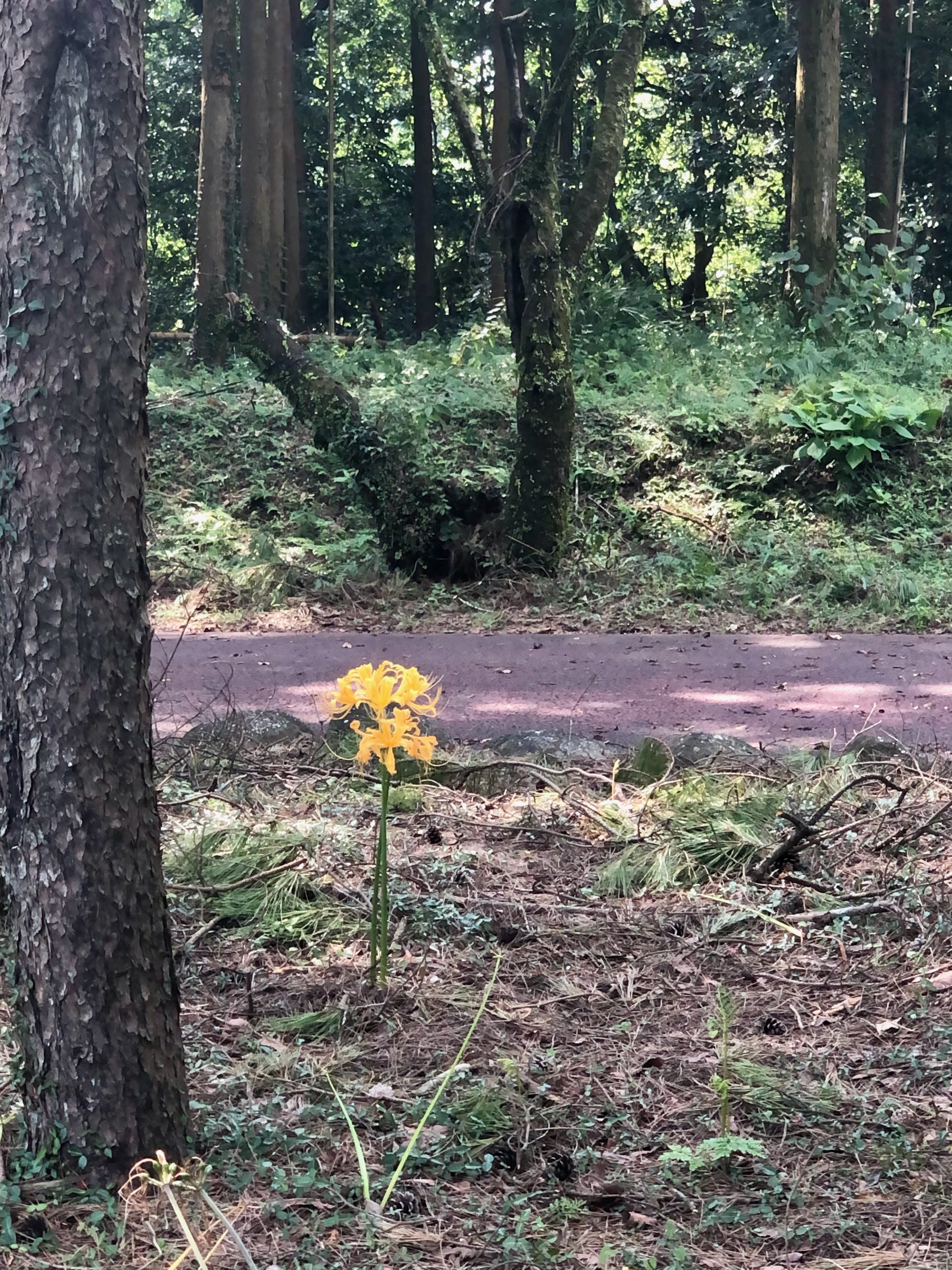 |
| タクシーの車窓から この場所は、 鹿児島県道60号国分霧島線国分・霧島線 と霧島川の間の緑地帯です。 9月29日撮影 From Taxi Window This place is a green belt between 'Kagoshima Prefectural Route 60 Kokubu-Kirishima Line' and the Kirishima River. Photograph on 29th .jpeg) 鍾馗水仙 / Golden Spider Lily |
Today
From 26th of September to 1st of October I and my sister Y
travelled to Kagoshima Prefecture.
Today, on the 29th, we went sightseeing from Kagoshima City to Kirishima Hot Springs Village with Kagoshima Kotsu Taxi's driver, S San.
On the way from 'Japan's Oldest Paddy Field Ruins' to Kirishima-jingu Shrine, I saw Yellow Red Spider Lilies.
About 'Japan's Oldest Paddy Field Remains', below.
From the first day we arrived in Kagoshima, I found yellow or white Amaryllidaceae (usually red spider lily) and became interested.
I had never seen a yellow or white Amaryllidaceae before.
Is it unique to Kagoshima?...I wondered.
Even if I was aware of its existence, there were times when I wasn't able to photograph it in time.
Today, I was able to photograph yellow spider lily from inside the taxi.
 |
| バスから 撮影時は、黄色い百合(?)と思い、次に色違いの 曼珠沙華 [マンジュシャゲ / 彼岸花 (ヒガンバナ)] なのかもしれないと思い、 曼珠沙華なら珍しいと思いました。 ヒガンバナ科鍾馗水仙とわかりました。 中国名は、龍爪花 (リュウソウカ)。 龍の爪の花!素敵な名前です。 (龍好きな私にとっては) 9月26日撮影 From Bus When I took the picture, I thought it was a yellow lily (?), and then I wondered if it might be a red spider lily in different colours, so I thought Amaryllidaceae (red spider lily) was rare. I found out that it is a Golden Spider Lily of the Amaryllidaceae family. The Chinese name is Ryusouka : 龍爪花. It means Flower of Dragon's Claw, this is lovely name for me who loves dragons. Photograph on 26th of September |
B. たくさんの名前 / Many Names
9月26日は、鹿児島空港から枕崎へ向かうバスの車窓から撮影し、
今日の撮影を含めて、曼珠沙華の撮影は、すべて、移動する乗り物からでした。
29日の撮影後は、その花を見ていません。
帰宅後、検索すると、白の花は、白花彼岸花 (シロバナマンジュシャゲ)といい、ヒガンバナと鍾馗水仙 (ショウキズイセン: ★/ 学名 : Lycoris Traubii W.Hayw.) の自然交雑種であることがわかりました: ★。
黄色は、鍾馗水仙または鍾馗蘭 (ショウキラン) と呼ぶようです。
['鍾馗蘭'で検索すると、違う形の花も出てくるので、鍾馗水仙の名前の方が一般的なのかもしれません。]
白花彼岸花は、九州では自生していますが、ほかの地域では観賞用に栽培されています。
(キュー・ガーデンのサイトでは、南日本から台湾にかけての自生と説明されています)
ここには、載せていませんが、曼珠沙華 (または彼岸花) 科の花達は日本名も英名も別名がとても多いです。
人々の想像力を掻き立てる色や形をしているからだと私は思います。
そう思った後、私は、人々の想像力を掻き立てる、そんな作品を作れたらいいなと思いました。
 |
| 電車から 白花彼岸花です。 9月28日撮影 From Train They are White Spider Lilies. Photograph on 28th of September |
Many Names
On 26th of September, I took the picture from the window of the bus heading from Kagoshima Airport to Makurazaki, and on the 28th from the window of the train heading from Makurazaki Station to Kagoshima Chūō Station.
All the Amaryllidaceae photographs, including today's photograph, were from moving vehicles.
I haven't seen the flower since photographing on the 29th.
After returning home, I searched and found out that the white flower is called White Spider Lily or Lycoris Albiflora (Shirobana Manjushage in Japanese : latin name ; Lycoris x albiflora Koidz, which is said to be a natural hybrid of Amaryllidaceae and Golden Spider Lily (Lycoris Traubii W.Hayw. in latin).
Yellow seems to be called Golden Spider Lily or Yellow Spider Lily or Lycoris Aures.
White Spider Lily grows wild in Kyushu, but is cultivated for ornamental purposes in other regions.
(On the Kew Gardens site, it is explained that 'The native range of this species is S. Japan to Taiwan.'.)
Although not listed here, the flowers of the red spider lily (or Lycoris) family have many names in both Japanese and English.
I think there are so many names because they have colours and shapes that capture people's imagination.
After thinking that way, I thought it would be great if I could make something that would stir people's imaginations.
2) お面 / Masks
A. 天狗じゃない / Not A Tengu
旅行前の検索で、霧島天狗館 (キリシマ テング カン)が、霧島神宮近くにあることを見つけていました。
お面には、誰かの、なにかの魂が宿っているようで、怖いです。
なので、計画にも入れませんでしたし、とにかく、29日、霧島天狗館は閉まっていました。
Sさんに
「霧島天狗館は天狗のお面がたくさんあるんですよね?」
と話だけふりました。
するとSさんは
「天狗じゃないですよ...」
と、そのあと、車は別の話題の風景の場所に行ってしまったので、天狗でないそれはいったい何であったのかを聞きそびれてしまいました。
もしかしたら、Sさんは話してくださったかもしれませんが、私が忘れてしまったのかもしれません。
【追記】
この地には、九面信仰があると知りました。
 |
| 霧島天狗館 Kirishima-Tangu-Kan (Kirishima Mask Museum) |
Not A Tengu
In my research before our trip, I found Kirishima-Tangu-Kan. : Kirishima Mask Museum near Kirishima-jingu Shrine.
For me who likes fantasy, Tengu ( Heavenly Sentinel) is interesting, but I felt that I was not good at spaces with many 'masks' → ★
I feel that it seems that someone's or something's soul resides in the mask, which is scary.
So I didn't include it in the plan for our trip, and anyway, Kirishima-Tangu-Kan was closed on the 29th.
I lightly asked S San,
“Kirishima-Tengu-Kan has many tengu masks doesn't it?”
"They are not Tengu..."
he said, after that, we went to another scenic spot, so I forgot to ask what it was that wasn't a tengu.
Maybe he told me, but I may have forgotten.
【Postscript】
I found out that there is a set of nine divine masks, known as 'Ku-men' in Japanese, in the area.
['Nine-faced' in Japanese : 'Ku-men' means relating to managemnet, money, business and so on].
[Ku means nine in Japanese.]
Below, from the Kirishima City website only in Japanese,
(Image of the Set can be seen on the city website.)
(translated by me)
"About 300 years ago, these nine masks were dedicated to Kirishima-jingu Shrine.
It is said that Genzaemon Ebihara, who was famous as a stonemason at the time, dedicated the masks, mainly Sarutahiko Ōkami of Gigaku masks.
It is said that worshiping these nine divine masks will improve one's work (nine-faced), so many people come to see them.
However, the Masks cannot be seen by the public. "
 |
| 霧島天狗館 Kirishima-Tangu-Kan (Kirishima Mask Museum) |
B. 猿田彦 / Sarutahiko Ōkami
帰宅後、検索し直すと、それは、猿田彦 [サルタヒコ / 猿田毘古神
(サルタヒコノカミ) / 猿田毘古大神 (サルタヒコノオオカミ)] であるとわかりました。
下の画像は猿田彦、さらにその下の画像は天狗、よく似ています。
まあ、どちらも架空の存在で、絵師の想像力によって生み出されたものです。
猿田彦は、日本神話に登場する神様、国津神 (クニツカミ) の一神で、猿田彦のほか、複数の名前を持っています。
猿田彦の容姿が一般に伝えられる天狗と似ていたところから、猿田彦のお面と天狗のお面が同一視されるようになったようでした。
下記、Wiki から引用。
『日本書紀』では、その神の鼻の長さは七咫(ななあた)、背(そびら)の長さは七尺(ななさか)、目が八咫鏡(やたのかがみ)のように、また赤酸醤(あかかがち)のように照り輝いているという姿であった。
[咫 (アタ)は、手を開いたときの中指の先から親指の先までの長さ、赤酸醤はホウズキです]
その神が国津神の猿田毘古神で、邇邇芸命らの先導をしようと迎えに来た。"
この館には、猿田彦のほか、天狗そのもののお面、ほかのお面、海外のお面も展示されているようです: ★。
 |
| 猿田彦 1850 - 1900 Sarutahiko Ōkami 1850 - 1900 画像は下記より / This from below ★ |
Sarutahiko
After returning home, I researched again and found that he meant Sarutahiko [Sarutahiko-no-Kami / Sarutahiko Ōkami : Sarutahiko God] was what I had thought was Tengu.
The images of Sarutahiko, above and Tengu, below are very similar.
Well, both are fictitious and created by the artist's imagination.
Sarutahiko is one of the Kunitsukami Gods in Japanese mythology and has multiple names besides Sarutahiko.
When Ninigi no Mikoto, the grandson of Amaterasu Ōmikami (the Goddess of the Sun), descended to earth, Sarutahiko guided him.
Since Sarutahiko's appearance resembled that of the Tengu, which is commonly known, it seems that Sarutahiko's mask and Tengu's mask came to be regarded as the same.
According to Wiki about Tengu,
"Tengu (Japanese: 天狗, lit. 'Heavenly Dog' or 'Heavenly Sentinel') are a type of legendary creature found in Shinto belief.
They are considered a type of yōkai (supernatural beings) or Shinto kami (gods or spirits).
The Tengu were originally thought to take the forms of birds of prey and a monkey deity, and they were traditionally depicted with human, monkey, and avian characteristics.
Sarutahiko Ōkami is considered to be the original model of Konoha-Tengu (a supernatural creature with a red face and long nose), which today is widely considered the Tengu's defining characteristic in the popular imagination.
He is the Shinto monkey deity who is said to shed light on heaven and earth. Some experts theorize that Sarutahiko was a sun god worshiped in the Ise region prior to the popularization of Amaterasu.
In addition to Sarutahiko, this museum seems to display Tengu's own masks, other masks, and masks from overseas: ★.
 |
"天狗の絵" 春日町兵主神社 "Tengu Painting" Kasugacho Hyoushu Shrine 画像は下記より/ This from below |

According to Wiki about "Gazu Hakki Yakoō"
"Gazu Hyakki Yagyō (画図百鬼夜行, "The Illustrated Night Parade of a Hundred Demons" or The Illustrated Demon Horde's Night Parade) is the first book of Japanese artist Toriyama Sekien's famous Gazu Hyakki Yagyō e-hon tetralogy, published in 1776.
A version of the tetralogy translated and annotated in English was published in 2016.
Although the title translates to "The Illustrated Night Parade of a Hundred Demons", it is based on an idiom, hyakki yagyō, that is akin to pandemonium in English and implies an uncountable horde."
次のセクションは、霧島神宮についてです。
The next section is about Kirishima-jingu Shrine.


